


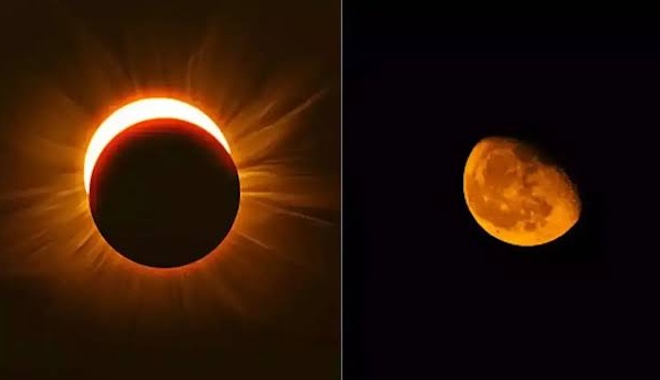
A rare total solar eclipse will occur on August 12, briefly turning day into night across parts of Europe as the Moon completely covers the Sun.
The eclipse, which will be the first total solar eclipse visible from mainland Europe since 2006, is expected to attract scientists, tourists and astronomy enthusiasts from around the world.
Solar eclipses occur when the Moon passes directly between the Earth and the Sun, casting a narrow shadow across the planet. During a total eclipse, daylight temporarily fades, temperatures can drop, shadows appear distorted and some animals may behave as though night has fallen.
According to experts, the phenomenon is possible because of what has been described as a cosmic coincidence. Although the Sun is about 400 times larger than the Moon, it is also approximately 400 times farther away from Earth, allowing the Moon to completely cover the Sun from certain viewing locations.
The eclipse will first be visible in a remote part of northern Russia before the path of totality moves across Greenland, Iceland, Spain and the northeastern tip of Portugal.
In Spain, the eclipse will travel from the northern city of Oviedo towards the island of Mallorca. Observers in some parts of the country will experience darkness for less than two minutes shortly before sunset.
For instance, residents of Burgos are expected to experience total darkness for approximately one minute and 48 seconds. Slightly longer durations are expected in parts of Russia and Greenland, although the total eclipse will still last less than two and a half minutes.
Partial phases of the eclipse, which occur before and after totality, will be visible for around one hour and 45 minutes. Partial eclipses are also expected to be seen across much of Europe, Canada, the northern United States and parts of northwestern Africa.
Astronomers note that while one or two solar eclipses occur somewhere on Earth almost every year, the narrow path of totality makes the event rare for specific locations. Some areas may wait several centuries before witnessing another total eclipse.
Experts have warned that people should never look directly at the Sun during the eclipse without certified eye protection, as doing so can cause serious and permanent eye damage. Observers are advised to use eclipse glasses that meet international safety standards.
The August eclipse is expected to be one of the most significant astronomical events of the year and will provide a rare opportunity for millions of people to witness one of nature’s most spectacular phenomena.