

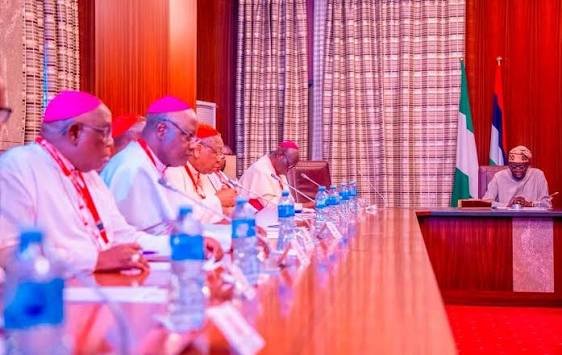
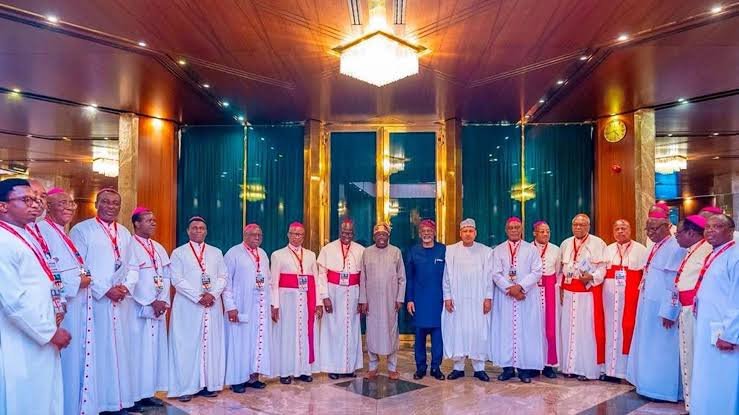
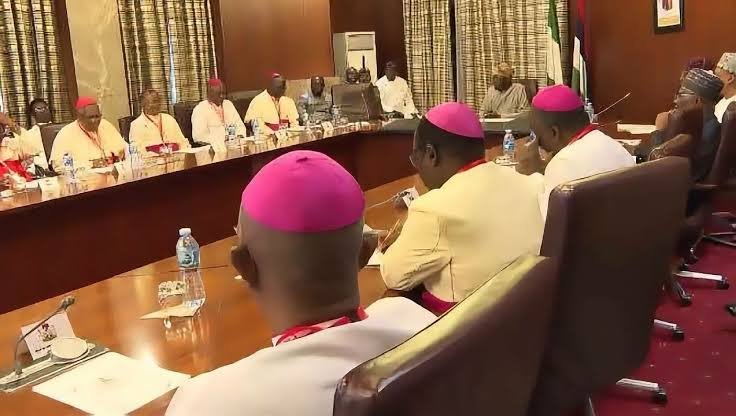
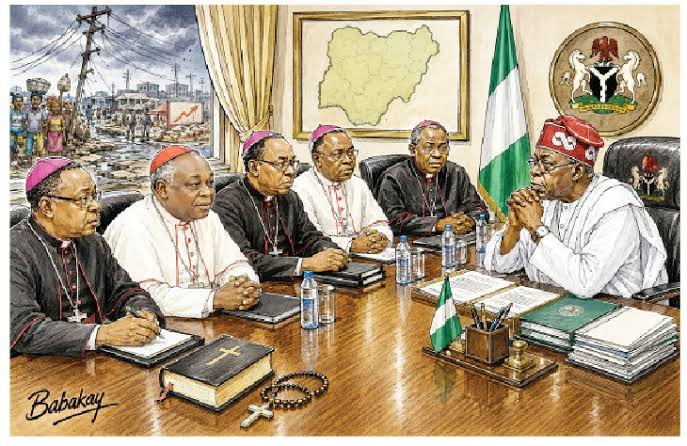
What began as a routine meeting between President Bola Ahmed Tinubu and Catholic bishops at the Presidential Villa in Abuja has evolved into one of the most significant conversations about leadership, accountability and governance in Nigeria in recent months.
At first glance, the controversy appeared to be another exchange between government officials and critics. But a closer look reveals a deeper debate, one that goes beyond politics and religion and strikes at the heart of democratic governance.
The question is simple:
How should leaders respond when respected institutions raise concerns about the state of the nation?
The controversy traces its roots to an engagement between President Tinubu and members of the Catholic Bishops’ Conference of Nigeria (CBCN), one of the country’s most influential religious bodies.
According to Cardinal John Onaiyekan, Archbishop Emeritus of Abuja, the bishops used the meeting to raise concerns about issues affecting millions of Nigerians, including insecurity, economic hardship and broader governance challenges.
The bishops’ intervention was not entirely surprising.
For decades, religious leaders in Nigeria have spoken on matters of public interest, often positioning themselves as moral voices during periods of national difficulty. From military rule to democratic governance, churches and mosques have frequently offered commentary on issues ranging from corruption and elections to poverty and insecurity.
What transformed the meeting into a national controversy was what happened afterward.
After speaking publicly about the engagement, Onaiyekan faced criticism from presidential aides who argued that details of a closed-door meeting should not have been disclosed. They also suggested that the bishops’ views represented only one segment of Nigerian society.
The response triggered fresh debate.
Was the issue really about confidentiality?
Or was it about criticism?
The controversy deepened when Onaiyekan granted a televised interview in which he defended the bishops’ position and pushed back against claims that they had acted improperly.
His argument was straightforward.
The issues discussed were not state secrets.
“Insecurity, is it a secret? Educational imbalance, is it a secret? The fact that the economy is very low, is it a secret?” he asked during the interview.
For the cardinal, the discussion was never about embarrassing the government. It was about highlighting concerns that many Nigerians already experience daily.
More significantly, the interview introduced what may be the central theme of the entire debate.
“People in positions of power must listen. And listening makes you stronger,” Onaiyekan said.
Those words resonated far beyond the immediate controversy.
In many ways, they captured the essence of democratic governance.
Democracy is not simply about elections.
It is also about dialogue.
It is about the ability of citizens, institutions and civil society groups to raise concerns without being viewed as enemies of the state.
Throughout history, some of the most influential voices in Nigeria’s public sphere have come from outside government.
Religious leaders, labour unions, civil society organisations, traditional rulers and the media have all, at various times, challenged governments to reconsider policies, address public concerns or respond more effectively to national crises.
These interventions have not always been welcomed.
Yet they remain an important part of democratic engagement.
The Tinubu administration has repeatedly emphasised its commitment to dialogue and partnership with faith leaders. President Tinubu himself has stated that interfaith engagement remains important for national peace and cohesion and has acknowledged the contributions of religious institutions to national development.
However, the latest controversy highlights the delicate relationship between power and criticism.
Governments often view their performance through economic indicators, policy reforms and administrative achievements.
Citizens and independent institutions frequently evaluate governments differently, through the lens of daily experience.
A government may point to reforms.
Citizens may point to rising living costs.
Government officials may cite security gains.
Communities affected by violence may focus on continuing threats.
Both perspectives can exist simultaneously.
This is why democratic societies require open conversations.
The challenge for every government is determining how to respond when criticism comes from influential voices.
Should criticism automatically be dismissed as political?
Should critics be viewed as opponents?
Or should such interventions be seen as opportunities for reflection?
The answers are rarely simple.
What is clear, however, is that the debate between the Presidency and the Catholic bishops has touched a nerve because it reflects wider frustrations and expectations within society.
In recent years, Cardinal Onaiyekan has consistently spoken on issues of insecurity and governance, arguing that government must do more to address persistent challenges facing ordinary Nigerians. Earlier this year, he called for stronger action against kidnapping and insecurity, insisting that authorities must intensify efforts to protect citizens.
His latest comments therefore fit within a broader pattern of engagement rather than a sudden intervention.
Whether one agrees with the bishops or with the Presidency is ultimately beside the point.
The larger issue is what the controversy reveals about leadership.
Strong democracies are not built solely through the exercise of power.
They are strengthened through dialogue, criticism and the willingness to hear uncomfortable truths.
As Nigeria moves closer to another election cycle, debates about governance, economic reforms and national security are likely to become even more intense.
Political leaders will continue to defend their records.
Religious leaders will continue to speak.
Citizens will continue to judge both.
The real test may not be who wins the argument.
The real test may be whether those entrusted with power remain willing to listen.
Because in every democracy, the ability to listen is often as important as the ability to lead.