For years, the Dangote Refinery was something most Nigerians could only look at from the outside.
A massive industrial project on the Lekki coastline. A refinery capable of processing hundreds of thousands of barrels of crude oil every day. A facility whose construction took years and billions of dollars.
But this September, something changed.
The refinery opened its doors, not physically to visitors, but financially to members of the public.
For as little as ₦5,250, an investor can apply for the minimum 10 shares being offered in the Dangote Petroleum Refinery and Petrochemicals Initial Public Offering, or IPO.
And suddenly, Nigerians who may never have imagined themselves as shareholders of a major industrial company are asking a very simple question:
Can ₦5,250 really buy me a piece of the Dangote Refinery?
The answer is yes, in the sense that subscribing for shares means seeking an equity interest in the company. But the bigger story lies in what that ownership means, why the refinery is raising the money, and what happens after the excitement surrounding the offer fades.
FROM A MEGA PROJECT TO A PUBLIC COMPANY
The Dangote Refinery did not become an overnight business story.
The project took years to build and cost about $20 billion, according to Reuters. It began operations in 2024 and has a crude processing capacity of about 700,000 barrels per day, making it Africa’s largest refinery.
Its significance goes beyond its physical size.
Nigeria spent decades relying heavily on imported refined petroleum products despite being one of Africa’s major crude oil producers.
The Dangote Refinery was designed to change part of that equation by processing crude domestically and supplying refined products to the Nigerian and international markets.
Its influence has increasingly extended beyond Nigeria.
Reuters reported that the refinery supplied about 80,000 barrels per day of jet fuel to Europe during the second quarter of 2026, while also increasing exports of diesel and gasoil. The refinery’s growing export activity has come at a time when disruptions to Middle Eastern fuel supplies tightened international markets.
That international demand has also coincided with a dramatic improvement in the refinery’s financial performance.
FROM LOSSES TO BILLIONS IN PROFIT
According to figures contained in the company’s IPO prospectus, the refinery generated more than $13 billion in revenue during the first half of 2026 and recorded a $1.82 billion profit after tax.
That represented a sharp turnaround from the $476 million loss recorded in 2025.
The numbers are significant because the IPO is arriving at a moment when the refinery is demonstrating its ability to operate at large scale.
But the circumstances behind the earnings also matter.
Reuters reported that disruptions to Middle Eastern fuel supplies helped lift refining margins and demand for the refinery’s exports during the period. That means the first-half performance should be viewed in the context of unusually tight global fuel markets, rather than automatically treated as a guarantee of future earnings.
And that distinction matters to anyone looking at the shares.
SO, WHAT EXACTLY IS NIGERIA BUYING?
The word IPO may sound like financial jargon, but the concept is relatively straightforward.
An Initial Public Offering is the process through which a company offers shares to the public for the first time.
Instead of the business being owned privately by a limited group of shareholders, members of the public can apply to buy shares and become shareholders.
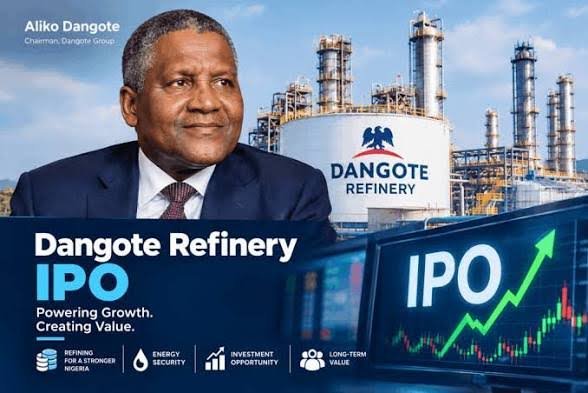
In the Dangote Refinery case, the company is offering 4.1 billion ordinary shares at ₦525 per share.
The base offer could raise approximately ₦2.15 trillion, equivalent to about $1.6 billion, if fully subscribed.
The offer opened on September 14 and is scheduled to close on October 13, 2026. The indicative timetable points to trading on the Nigerian Exchange later in November.
The minimum subscription is 10 shares.
At ₦525 per share, that comes to:
10 shares = ₦5,250.
But ₦5,250 does not mean an investor is buying a physical piece of the refinery.
There is no portion of the refinery that belongs exclusively to a particular shareholder.
Rather, the investor owns shares in the company, giving them an equity interest according to the number of shares allotted to them and the rights attached to those shares.
And there is another important distinction.
Buying shares does not mean guaranteed profit.
The value of shares can rise or fall after they begin trading, and the future performance of the company can affect their market value.
WHY IS DANGOTE RAISING THE MONEY?
The IPO is not simply about putting shares in the hands of Nigerians.
There is a much larger expansion plan behind it.
Dangote Refinery plans to invest about $14.3 billion to expand its processing capacity from around 700,000 barrels per day to 1.4 million barrels per day by 2029.
That means the refinery is trying to move from being a giant refinery to an even larger refining and petrochemical operation.
The IPO therefore forms part of a broader financing strategy for the company’s expansion.
In simple terms, the company is opening part of its ownership to the public while seeking additional capital to grow the business.
WHY CALL IT A “PEOPLE’S IPO”?
This is where the story becomes more interesting.
The offer has been marketed as a “People’s IPO”, partly because of the low minimum subscription and the emphasis on retail participation.
The minimum of 10 shares means that someone does not need millions of naira simply to enter the offer.
The structure has attracted significant attention from small investors.
By September 18, the IPO had already moved beyond conventional business conversations and into Nigerian pop culture.
Reuters reported a wave of memes portraying small investors as newly appointed business partners, board members and advisers to Aliko Dangote.
Some digital investment platforms also experienced outages as retail investors rushed to participate.
The jokes may be humorous, but they reveal something serious about the moment.
A major industrial asset that previously seemed distant from ordinary Nigerians is suddenly being discussed in terms of ownership.
BUT HOW MUCH OF THE REFINERY DOES THE PUBLIC ACTUALLY OWN?
This is one of the details that can easily get lost in the excitement.
The IPO does not mean that Dangote is handing over control of the refinery to the public.
The Associated Press reported that Aliko Dangote would retain about 87 per cent ownership following the offering.
So while the public can become shareholders, the company remains overwhelmingly controlled by its existing ownership.
That means a person who buys the minimum 10 shares should not imagine that they have suddenly become a decision-maker at the refinery.
They have acquired an equity interest, but the size of that interest is extremely small.
The “people’s” element of the offer is therefore primarily about widening access to ownership, rather than transferring control of the business.
THE BIGGER QUESTION: CAN THIS CHANGE HOW NIGERIANS INVEST?
Perhaps this is where the Dangote IPO becomes bigger than Dangote himself.
For many Nigerians, the stock market can appear complicated and distant.
Shares, brokers, prospectuses, allotments, dividends, market prices and capital gains are terms many people hear without necessarily understanding how they work.
The Dangote IPO has pushed those conversations into everyday spaces.
Someone who may never have searched for information about the Nigerian Exchange is now asking how shares work.
Someone who has never owned a stock is asking whether ₦5,250 can make them a shareholder.
And someone who normally follows Dangote through cement, sugar or consumer products is now paying attention to a company’s financial statements.
That attention, however, is only the beginning.
An IPO can introduce people to the capital market, but becoming an informed investor requires understanding what is being purchased, how companies make money, what risks exist and how share prices behave after listing.
THE RISKS BEHIND THE EXCITEMENT
The excitement surrounding the offer also comes with a need for caution.
The Securities and Exchange Commission has specifically warned prospective investors to use only officially designated and approved receiving agents, subscription channels and platforms.
The regulator has also advised investors to verify websites and platforms before providing personal or financial information, avoid unsolicited WhatsApp messages and social-media offers, and not transfer money to people or entities claiming to receive IPO subscriptions outside approved channels.
The SEC also urged investors to read the approved prospectus and understand the terms, conditions and risks before subscribing.
That warning is particularly relevant because the popularity of the IPO has created an opportunity not only for investors, but also for fraudsters.
The rule is simple:
The excitement should never be greater than the due diligence.
FROM ₦5,250 TO A SHARE OF NIGERIA’S INDUSTRIAL STORY
The Dangote Refinery IPO is ultimately about more than a price tag.
It is about a refinery that has moved from years of construction into full-scale commercial operations.
It is about a company that has reported a dramatic turnaround in profitability while benefiting from strong international demand for refined products.
It is about an ambitious plan to double processing capacity to 1.4 million barrels per day.
And now, it is also about ordinary Nigerians being given access to a small ownership stake in one of the country’s most prominent industrial projects.
Whether the IPO becomes the beginning of a lasting culture of retail investment or simply another moment of intense financial excitement will depend on what happens after the memes disappear and the shares begin trading.
For now, the question is no longer whether Nigerians can own a piece of the refinery.
They can apply to.
The bigger question is what Nigerians will do with that new relationship with the capital market, and whether the ₦5,250 entry point becomes, for some, the beginning of understanding what it really means to own a share in a business.