

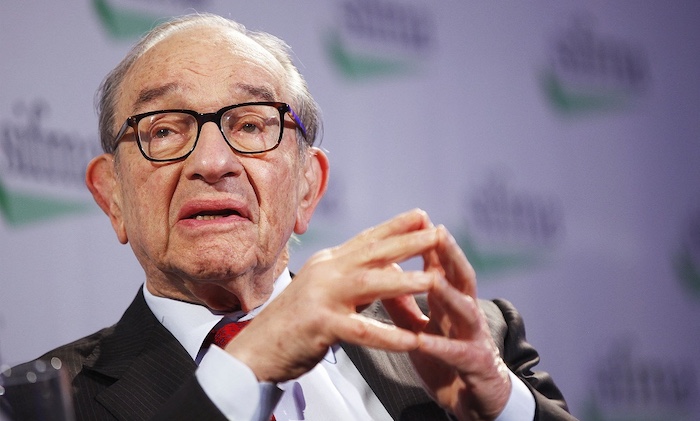
Alan Greenspan, former chairman of the United States Federal Reserve, has died at the age of 100 from complications of Parkinson’s Disease. His wife, NBC News correspondent Andrea Mitchell, confirmed his death in a statement, describing him as “a giant of a man who helped shape the US economy for decades under presidents of both parties, but was always honest in acknowledging his mistakes.”
Greenspan served as Fed chairman from 1987 to 2006, a period during which he presided over the longest sustained economic expansion in a generation. Often described as the “God in the machine” of American finance, he was notoriously press-shy during his tenure, yet financial markets and media alike hung on his every public word.
Critics, however, argue that his reliance on easy credit policies contributed to the dot-com bubble of the late 1990s and helped set the conditions for the 2008 subprime mortgage crisis.
Born in New York City on March 6, 1926, Greenspan studied economics at New York University before building a career as an economic consultant and later a JP Morgan board member. His early advisory work included accurately predicting the Eisenhower recession and advising Richard Nixon during his 1968 presidential campaign, though he later wrote that he found Nixon “sadly paranoid, misanthropic and cynical.”
He served on the Council of Economic Advisers under Gerald Ford and led a Reagan-commissioned inquiry into pension reform before being elevated to Fed chairman in August 1987. His measured response to the stock market crash that October, when share prices fell more than 30 percent, established his reputation for steadying markets under pressure. That approach, later formalised as quantitative easing, became a recurring tool through subsequent crises including the Gulf War, the Mexican peso crisis, and the 2008 global credit crunch.
Greenspan was renominated by George H.W. Bush and, notably, retained by Democrat Bill Clinton, under whose administration a late-1990s growth boom followed. He later praised Clinton in his memoir for his “consistent, disciplined focus on long-term economic growth,” while criticising some Republican administrations for losing control of public spending.
He retired in 2006 after an unprecedented five terms, having received the Presidential Medal of Freedom and an honorary knighthood from Queen Elizabeth II. He remained an active public voice well into his nineties, criticising Donald Trump’s first administration and calling Brexit the “worst outcome” for Britain. He celebrated his 100th birthday in March 2026.