

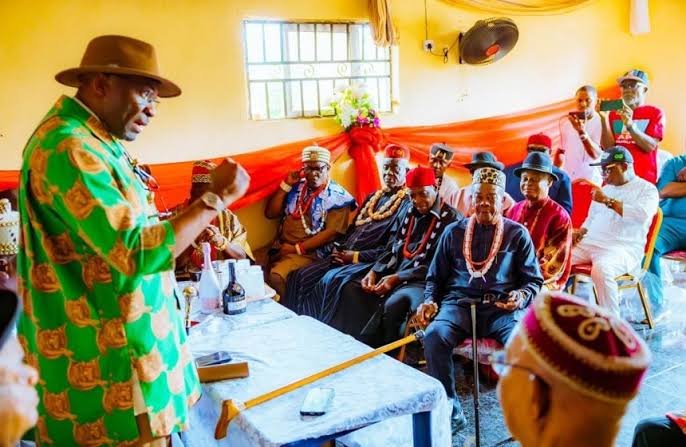
A viral video allegedly showing a traditional ruler in Bende Local Government Area making remarks about voters who might not support Deputy Speaker of the House of Representatives Benjamin Kalu ahead of the 2027 election has drawn sharp criticism from a Bende indigene, who says the comments cross a line traditional institutions shouldn’t approach.
The monarch’s identity has not been publicly disclosed, but in a statement issued Friday in Umuahia, Peter Ekekwe described the reported remarks as inappropriate, framing them as part of a broader and troubling trend of traditional rulers wading into partisan politics. For Ekekwe, the core issue is constitutional: voters have a guaranteed right to choose candidates freely, without pressure from any authority, traditional or otherwise. “A healthy democracy relies entirely on the freedom of citizens to think, choose and associate without fear. Every Nigerian who has attained the legal voting age is mature enough to make an independent political decision guided by conscience, conviction and the truth,” he said.
Ekekwe argued that neither traditional rulers nor political figures should attempt to shape how citizens cast their votes, insisting that the responsibility of a monarch runs in the opposite direction entirely, toward unifying communities rather than dividing them along political lines. “Our traditional rulers occupy sacred stools because they are expected to unite their people irrespective of political affiliation. The palace should never become a campaign office. The throne belongs to every son and daughter of the community, not to any political party or candidate,” he said.
At the heart of his argument is a clear separation between political legitimacy and traditional authority. Ekekwe maintained that political leadership ought to be earned through public trust, integrity, and demonstrated service, not through pressure exerted from positions of cultural or spiritual influence. He called on political actors more broadly to campaign peacefully and allow voters the space to make independent decisions, framing this as essential to preserving both democratic values and the neutrality traditional institutions are meant to embody. He closed by urging traditional rulers nationwide to remain above partisan politics, continuing instead to serve as unifying figures for every member of their communities regardless of political leaning.