President Bola Tinubu yesterday challenged Nigerian banks to move beyond balance-sheet expansion and profitability by deploying more capital to productive businesses capable of driving investment, job creation, and economic growth
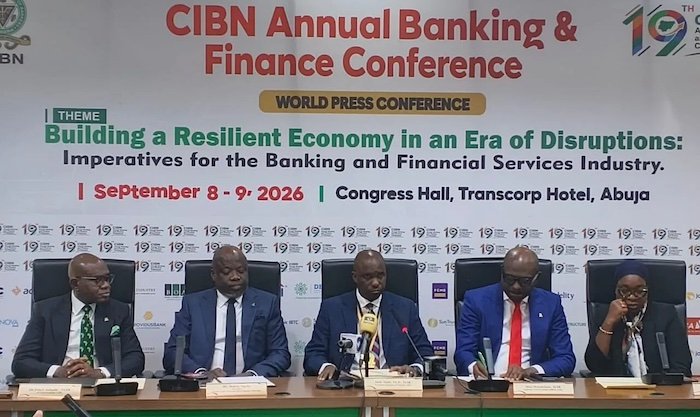
Tinubu spoke at the opening of the 19th Annual Banking and Finance Conference of the Chartered Institute of Bankers of Nigeria (CIBN) in Abuja.
The conference had the theme, “Building a Resilient Economy in an Era of Disruptions: Strategic Imperatives for the Banking and Financial Services Industry.”
Tinubu declared that the banking industry must shift from financial intermediation to economic transformation.
Represented by Minister of Finance and Coordinating Minister of the Economy, Mr. Taiwo Oyedele, the president said the country’s improving macroeconomic stability should not be mistaken for prosperity, stressing that the ultimate objective of the ongoing reforms is to translate stability into investment, production, jobs, and improved living standards.
Governor of Central Bank of Nigeria (CBN), Mr. Olayemi Cardoso, said the country’s economic recovery could not be sustained without a strong and high-performing banking sector.
Cardoso, who spoke at the CIBN conference, acknowledged the sacrifices made by banks and other stakeholders during the reform process, saying the reforms would soon yield concrete benefits.
CBN stepped up its focus on terrorism financing risks across the financial sector, making it a supervisory priority as it moves to strengthen safeguards against the misuse of the financial system.
That was as the Economic Management Team (EMT), the federal government’s principal platform for economic management and coordination, approved the establishment of a dedicated inter-agency committee to harmonise the macroeconomic assumptions underpinning government’s budgeting and economic planning.
At the CIBN event, also, World Bank Country Director for Nigeria, Mr. Mathew Verghis, challenged banks to redirect capital from government securities towards businesses capable of creating jobs.
Verghis warned that the current structure of bank profitability could come under pressure as interest rates declined.
President/Chairman of Council of CIBN, Dr. Dele Alabi, said the ultimate test of economic reforms would be whether improved macroeconomic indicators translated into tangible improvements in the lives of citizens.
Tinubu told the audience at the conference, “A resilient banking system cannot exist indefinitely where businesses cannot obtain affordable credit. Manufacturing that is struggling cannot expand, and millions of productive companies remain outside the formal financial system.”
He said the current phase of the country’s reform journey was accelerating the conversion of stability into investment, investment into production, production into jobs, and growth into improved living standards.
Tinubu said the banking and financial services industry was central to the current transformation process.
“Therefore, we need to move from intermediation to transformation,” he stated.
The president explained, “For years, we have measured financial institutions by balance sheet growth, profitability, and shareholder returns. These remain important, but we must increasingly ask: what is the financial system doing for the real economy?
“A resilient banking system cannot exist indefinitely where businesses cannot obtain affordable credit.
“Manufacturing that is struggling cannot expand, and millions of productive companies remain outside the formal financial system.”
Tinubu urged banks to reassess how they allocated capital, stressing that the success of the recently concluded banking recapitalisation exercise should be measured by its impact on the real economy rather than merely by larger balance sheets.
“A bigger bank that does not finance a more productive economy is a suboptimal outcome,” he said.
The president said the federal government was strengthening guarantees, risk-sharing arrangements, blended finance and credit enhancement mechanisms, with the National Credit Guarantee Company at the centre of efforts to crowd private capital into productive investments.
He explained that the government’s measure of success should increasingly shift from the volume of public spending to the amount of productive private capital it could catalyse.
Tinubu identified growth facilitation, financial inclusion, technology, long-term capital, and trust as five imperatives for building a resilient financial system.
On inclusion, he said access to a bank account was not enough, stating that genuine financial inclusion should enable small businesses to obtain affordable working capital while allowing young entrepreneurs to borrow based on viable cash flows rather than collateral they might not possess.
The president called for greater deployment of patient capital to infrastructure, industry, housing, and energy, stressing that long-term development cannot be financed predominantly with short-term funds.
He said the government’s reforms were already producing stronger macroeconomic indicators, citing 4.43 per cent real GDP growth in the second quarter of 2026, headline inflation of 15.43 per cent, and foreign reserves of more than $54 billion.
Tinubu also pointed to Nigeria’s removal from the Financial Action Task Force grey list, its exit from European Union’s AML/CFT deficiency list, the planned reclassification of the country by FTSE Russell as a Frontier Market, and improving investor confidence, as evidence of progress.
However, he cautioned that the gains represented the foundation rather than the final objective.
Tinubu said, “Stability is the foundation; prosperity is the destination,” adding that the next phase of reforms must accelerate the conversion of “stability into investment, investment into production, production into jobs, and growth into improved living standards”.
The president urged banks to move away from excessive reliance on government securities, which he said had made lending to productive businesses comparatively less attractive.
He envisaged a cycle in which stronger fiscal discipline would reduce government borrowing pressure; lower inflation; support lower interest rates and affordable capital; stimulate investment and production; and generate jobs, incomes, and tax revenues.
Tinubu also challenged banks to see Nigerian businesses as potential regional champions, particularly with access to the African Continental Free Trade Area market of more than 1.4 billion people.
He said the next chapter of Nigeria’s development should not merely produce larger financial institutions but “a bigger and more productive economy where capital reaches and gets”.
Cardoso: No Economy Can Thrive with Weak Banks
Speaking at the conference, Cardoso said the country’s economic recovery could not be sustained without a strong and high-performing banking sector, while acknowledging the sacrifices made by banks and other stakeholders during the reform process.
Represented by CBN Deputy Governor, Economic Policy Directorate, Mr. Philip Ikeazor, Cardoso said the macroeconomic stability achieved by the central bank was the product of unprecedented collaboration between the monetary and fiscal authorities.
He credited Tinubu for granting CBN the independence to focus on its mandate, while commending the fiscal authorities, led by the Coordinating Minister of the Economy, for their cooperation.
According to him, the major question now should be when ordinary Nigerians would begin to feel the full benefits of the reforms.
“That is on its way,” he said, explaining that some of the fiscal reforms underway, alongside monetary policy measures, would soon begin to translate into tangible benefits.
Cardoso said banks deserved recognition for their role in supporting the economy and for successfully completing the recapitalisation exercise.
He said the exercise demonstrated both the depth of Nigeria’s domestic capital market and investors’ confidence in the economy. He disclosed that banks raised about N4.65 trillion from the domestic market.
Cardoso stated, “Charity began at home. Our people put their money down — N4.65 trillion. So, when you see the confidence outside, it was also driven by that.”
The CBN governor also acknowledged the cost of the monetary adjustment undertaken to contain inflation, saying the central bank has deployed substantial liquidity management measures while returning to orthodox monetary policy.
He added that the fiscal authorities also bore significant financing costs during the adjustment period.
Cardoso said the country was now moving towards disinflation, adding that the CBN is working with the fiscal authorities and state governments to bring inflation under control and, ultimately, push it towards single digits.
World Bank: Banks Must Redirect Capital Towards Job-creating Sectors.