


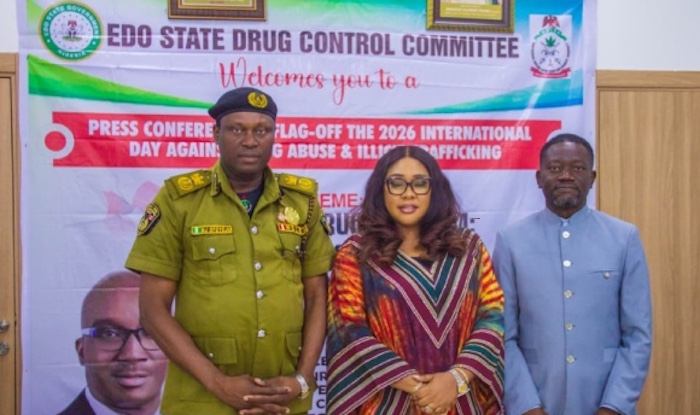
The Edo State Government held a press conference in Benin City on Monday to reaffirm its commitment to tackling drug abuse and illicit trafficking across the state. Officials from the Drug Control Committee, the National Drug Law Enforcement Agency, and the Ministry of Health all spoke. The messaging hit on important factors such as awareness campaigns, school sensitisation programmes, community outreach, and stronger rehabilitation services are coming.
What made the event worth more than a standard government briefing was a moment of candour from Drug Control Committee Chairperson Edesili Anani, who named poverty, unemployment, inadequate education, and social inequality as the primary drivers of drug abuse in the state. That acknowledgement matters because it shifts the frame. A drug problem addressed only through enforcement and awareness treats the symptom. One that also confronts why people are reaching for substances in the first place is engaging the disease.
The 2026 global theme for drug control, The World Drug Problem: persisting issues, new challenges, and the need for innovative responses, captures the core the discussion.
NDLEA Edo State Commander Mitchell Ofoyeju reinforced the point by flagging the growing abuse of shisha and other new psychoactive substances as an emerging threat that existing frameworks were not designed to contain. Old strategies applied to new substances produce predictable results.
The scale of coordination being called for is substantial. Anani appealed to parents, educators, healthcare workers, community leaders, and civil society organisations to collectively build the kind of social environment in which young people are less likely to turn to drugs. This implicit admission reinforces that no single government agency, however well-resourced, can solve this alone.
Commissioner for Health Cyril Oshiomhole committed to expanding rehabilitation facilities and strengthening mental health service delivery, connecting drug abuse to the broader public health infrastructure in a way that enforcement-led responses often fail to do. Rehabilitation without adequate mental health support tends to produce relapse rather than recovery.
The scheduled interventions, public campaigns, school visits, and community programmes, are necessary. They are also the easier part of what Anani’s own diagnosis demands. Reducing drug abuse in Edo State over the long term will require measurable progress on the conditions she named including poverty, unemployment, and inequality. Awareness campaigns do not address those but policy does.