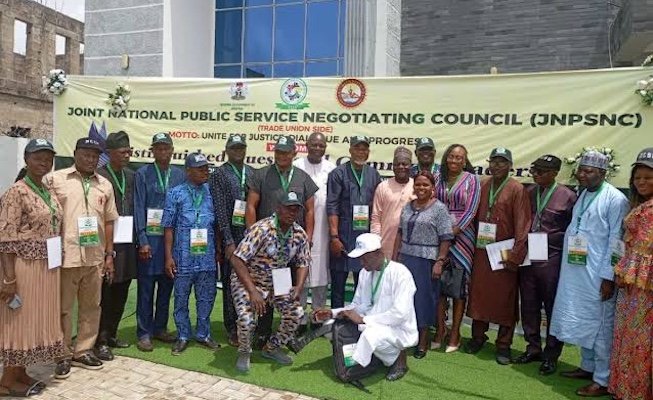
Public servants under the Joint National Public Service Negotiating Council (JNPSNC) have threatened to commence a three-day nationwide warning strike on October 2 if the Federal Government fails to address their demands over petrol prices, wage relief and negotiations for a new national minimum wage.
The council said its September 30 deadline remains unchanged, with workers expecting President Bola Tinubu to respond to their concerns in his Independence Day address.
The JNPSNC, which comprises eight public sector unions, said it had mobilised its members nationwide for the proposed industrial action should the government fail to take steps on the issues raised in its September 21 letter to the President.
Among the council’s demands is a reduction of the pump price of Premium Motor Spirit (PMS), commonly known as petrol, to N500 per litre. It also wants the government to introduce an immediate wage award to cushion workers against rising living costs and establish a tripartite committee to begin negotiations for a new national minimum wage expected to take effect in 2027.
According to the JNPSNC, petrol prices currently ranging from about N1,450 to N2,500 per litre in some parts of the country have placed considerable pressure on workers and their dependants.
The council proposed the creation of an intervention fund to address landing costs and support operators in the oil and gas sector. It also called for crude oil to be supplied to the Dangote Refinery and modular refinery operators on terms that would encourage increased domestic refining and potentially reduce petroleum prices.
On wages, the council said an immediate wage award was necessary to provide relief from the current economic difficulties. It argued that improved welfare would also support workers’ commitment and productivity within the public service.
The council further called for the early establishment of a tripartite committee involving government, labour and other stakeholders to begin negotiations for the next minimum wage. It said early negotiations would help prevent delays in the eventual implementation of a new wage structure.
The eight unions under the JNPSNC include the Nigerian Civil Service Union, Medical and Health Workers Union, Association of Senior Civil Servants of Nigeria and National Association of Nigerian Nurses and Midwives.
The Nigeria Labour Congress (NLC) has also expressed support for the public sector unions’ position. NLC Assistant General Secretary Chris Onyeka said the hardship affecting public servants was also being experienced by private-sector workers, state employees and informal-sector workers.
Onyeka urged the government to introduce measures to reduce the pressure on Nigerians and warned that failure to address the unions’ demands could lead to broader industrial action.
Meanwhile, efforts to obtain a response from the Federal Ministry of Labour and Productivity were unsuccessful. A ministry source, however, said the matter was being handled by the appropriate government authorities.