

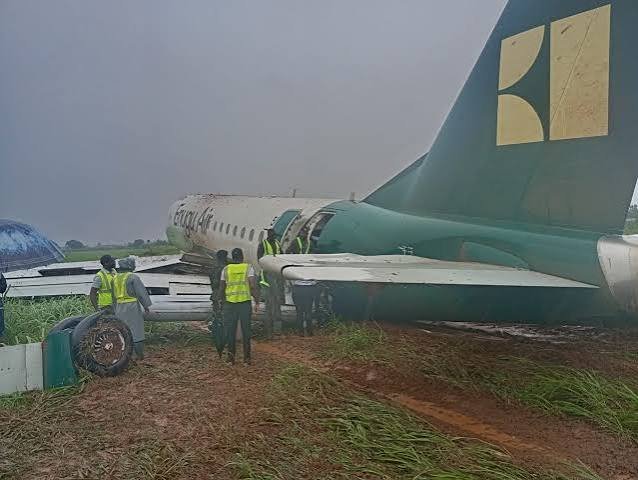
When news broke that an Enugu Air aircraft had skidded off the runway at Benin Airport on July 23, many Nigerians experienced a familiar feeling of anxiety.
Although all 63 passengers and five crew members on board escaped unharmed, the incident quickly reignited conversations about aviation safety, airline operations and public confidence in Nigeria’s air transport system.
For some travellers, every aviation incident raises questions about whether the country’s skies are truly safe. For others, it is a reminder that aviation, despite being one of the safest modes of transportation globally, can never be entirely free of risk.
The occurrence of an aviation incident does not automatically mean an aviation system is unsafe. Aviation safety is typically assessed through a range of indicators, including regulatory oversight, accident rates, compliance with international standards, incident reporting and the effectiveness of investigations and corrective actions.In fact, the true measure of a country’s aviation sector is not whether incidents occur, but how effectively the system responds when they do.
Nigeria’s aviation industry has experienced periods of significant turbulence.
The early and mid-2000s were particularly difficult years for the sector. A series of air crashes raised serious concerns about airline operations, regulatory oversight and safety compliance.
Among the most notable incidents were the Bellview Airlines crash in 2005, the Sosoliso Airlines crash later that same year and the ADC Airlines crash in 2006.
Those tragedies claimed hundreds of lives and triggered widespread calls for reform.
In response, aviation authorities introduced stricter regulatory measures, strengthened certification processes and enhanced safety oversight.
The Nigeria Civil Aviation Authority (NCAA) emerged as a stronger regulator, while investments were made in training, surveillance and compliance monitoring.
Over time, these reforms contributed to significant improvements in safety performance.
Today’s aviation landscape differs considerably from that of two decades ago.
Nigeria now operates under a more robust regulatory framework aligned with international standards established by the International Civil Aviation Organization (ICAO).
Airlines undergo certification and regular inspections, while pilots, engineers and other aviation personnel are subject to licensing and competency requirements.
The Nigerian Safety Investigation Bureau (NSIB) investigates accidents and incidents independently, providing recommendations aimed at preventing future occurrences.
This system does not eliminate risk, but it creates multiple layers of protection designed to minimise it.
The runway excursion involving Enugu Air illustrates how these mechanisms work.
Within hours of the incident, the NSIB announced an investigation while the Federal Ministry of Aviation and Aerospace Development directed relevant agencies to determine the cause.
The swift response reflects procedures that have become standard practice within modern aviation systems.
Runway excursions are among the most common types of aviation incidents worldwide.
They occur when an aircraft veers off or overruns a runway during take-off or landing.
According to global aviation safety organisations, runway excursions account for a significant proportion of aviation incidents internationally.
Such occurrences are not unique to Nigeria.
Major aviation markets, including the United States, Canada, the United Kingdom and several European countries, have recorded similar incidents involving both regional and major airlines.
Factors often associated with runway excursions include adverse weather conditions, reduced visibility, runway surface conditions and operational challenges during landing.
The ongoing investigation into the Enugu Air incident is expected to determine the specific circumstances involved.
One challenge facing the aviation industry is that public perception is often shaped by headlines rather than long-term safety data.
A single incident can generate widespread concern even when the broader safety record shows improvement.
Aviation specialists frequently note that flying remains one of the safest means of transportation globally.
Commercial aviation’s safety culture is built around continuous learning, incident reporting, independent investigations and corrective action.
Every incident, no matter how minor, is analysed to identify lessons that can improve future operations.
This culture of learning is one reason why aviation has achieved remarkable safety improvements over the decades.
Following the Enugu Air runway excursion, Governor Peter Mbah reassured the public that the airline remains committed to maintaining high safety standards.
According to him, safety remains the airline’s highest priority and forms the foundation of its operational culture.
Minister of Aviation and Aerospace Development Festus Keyamo also confirmed that all passengers and crew members were safe while directing relevant agencies to investigate the occurrence thoroughly.
Similarly, the NCAA has consistently maintained that safety remains non-negotiable within Nigeria’s aviation sector.
The authority has repeatedly emphasised the importance of regulatory compliance, continuous surveillance and adherence to international best practices.
Speaking on several occasions, NCAA officials have stressed that strong oversight is essential to protecting passengers and sustaining confidence in the aviation system.
This position was recently reinforced during discussions surrounding aviation funding, where the authority argued that effective regulation requires adequate resources to support inspections, training and safety monitoring.
While challenges remain, Nigeria’s aviation sector has recorded improvements that have attracted recognition within international aviation circles.
The country has maintained ICAO certification standards and continues to participate in global aviation safety audits.
Industry observers note that many of the challenges facing Nigerian aviation are not unique.
Airlines around the world contend with weather-related disruptions, technical incidents, operational pressures and infrastructure limitations.
What distinguishes a mature aviation system is the ability to identify risks, investigate occurrences and implement corrective measures.
In this regard, Nigeria has continued to strengthen its institutional framework over the years.
Despite the progress made, legitimate concerns persist.
Passengers continue to raise questions about airport infrastructure, weather-related disruptions, flight delays and operational efficiency.
There are also ongoing discussions about the need for greater investment in navigational equipment, runway improvements, personnel training and airport modernisation.
As air travel demand increases, maintaining safety standards will require continuous investment and vigilance.
Public confidence is one of the aviation industry’s most valuable assets.
Without trust, passengers are less likely to fly, airlines struggle to grow and the sector’s contribution to economic development is diminished.
The response to incidents therefore matters almost as much as the incidents themselves.
For many Nigerians, the fact that all passengers and crew members survived the Enugu Air runway excursion is a reminder of how aviation safety systems are designed to protect lives even when operations do not go as planned.
While investigations will determine exactly what happened in Benin, the broader lesson is that aviation safety is not measured by the absence of incidents alone.
It is measured by preparedness, oversight, transparency and the willingness to learn from every occurrence.
As Nigeria’s aviation sector continues to expand, the challenge will be to maintain public confidence while addressing the concerns that incidents inevitably raise.
For now, aviation remains a critical connector of people, businesses and opportunities across the country.
And despite occasional turbulence, the evidence suggests that Nigeria’s aviation system today is significantly stronger, more regulated and more safety-conscious than it was two decades ago.
The task ahead is ensuring that progress continues, one safe flight at a time.