


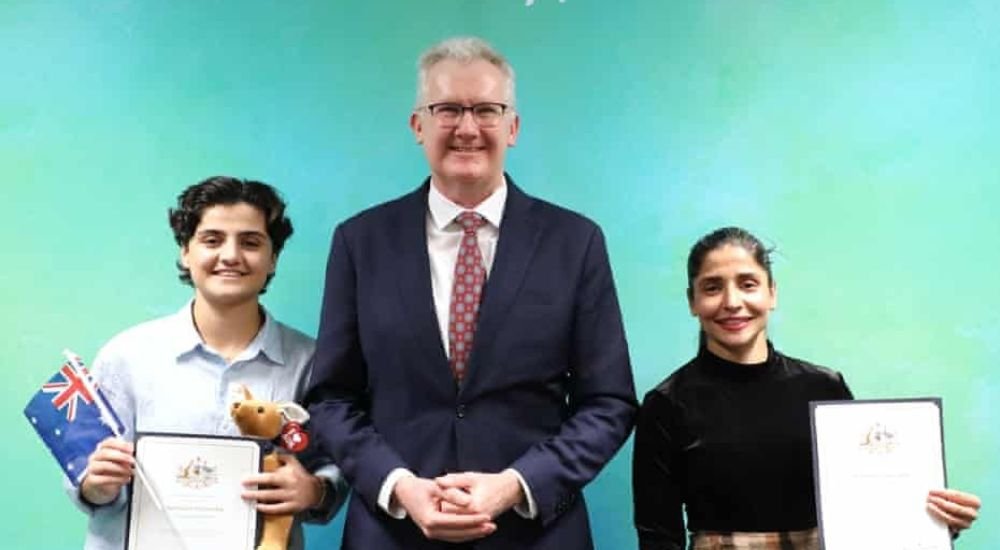
Two former members of Iran’s women’s national football team have become Australian citizens, capping a months-long ordeal that began with a defiant on-field protest and ended with them branded traitors by their own country’s leadership.
Fatemeh Pasandideh and Atefeh Ramezanisadeh were part of a group of seven players from Iran’s delegation who sought Australia’s protection following a high-profile refusal to sing the national anthem before a match at the women’s Asian Cup in March. The gesture proved deeply embarrassing for Iranian authorities while drawing praise from US President Donald Trump, and put the players at the center of an international standoff over their fate. Five of the seven eventually reversed course and returned to Iran, but Pasandideh and Ramezanisadeh chose to remain, and were formally granted Australian citizenship at a ceremony Wednesday overseen by Interior Minister Tony Burke.
For both players, the moment carried significant emotional weight. “Yesterday was a truly special and unforgettable day for me. I feel proud and deeply grateful to become an Australian citizen,” Ramezanisadeh said in a statement. Pasandideh echoed that sentiment, reflecting on the difficulty of the path that led them there. “After everything we’ve been through and all the challenges we faced, this moment means more than words can express,” she said.
Their transition to life in Australia has already included a return to football. Just a week after seeking asylum, the pair were photographed training and smiling with Brisbane Roar, the Australian club that publicly congratulated them following Wednesday’s citizenship ceremony. A club spokesman acknowledged the scale of what the two had endured since February, calling it “more than most people deal with in a lifetime,” and praised their resilience in reaching this point. The club extended an open invitation for the pair to continue training with them going forward, declaring that “Queensland is their home now” and that the door would always remain open if they wanted to return.
The fate of the five teammates who chose to go back to Iran remains far less clear. AFP reporters observed them crossing into Iran from Turkey by bus, still dressed in their national team tracksuits with their hair covered. Iranian Parliament Speaker Mohammad Bagher Ghalibaf quickly moved to frame their return as a national vindication, describing the players and their support staff on social media as “children of the homeland” who would be embraced by the Iranian people. He characterized their decision to return as a rejection of outside pressure, saying they had “disappointed the enemies of Iran and did not surrender to deception and intimidation by anti-Iran elements.”