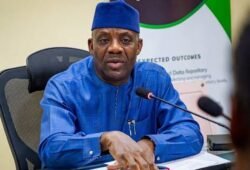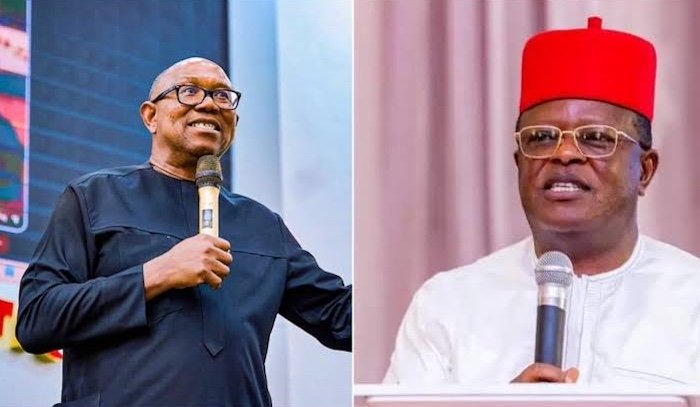
The Minister of Works, Senator David Umahi has urged Igbo political leaders and stakeholders to look beyond sentiments and carefully examine the political implications of their decisions ahead of the 2027 general election.
Umahi who gave the charge while addressing the Christian Association of Nigeria (CAN) in the South-East, representatives of Hausa and Yoruba communities, and other prominent stakeholders during an engagement meeting held at the Christian Ecumenical Centre and Osborn Hotel in Abakaliki, Ebonyi State accused the former Anambra State Governor and the presidential candidate of the Nigeria Democratic Congress (NDC), Peter Obi of allegedly attempting to mortgage the political destiny of the Igbo people through what he described as a unilateral arrangement that could limit the region’s quest for the presidency to four years.
The minister declared that President Bola Ahmed Tinubu will win the 2027 presidential election, irrespective of opposition efforts, while challenging Obi, to explain who authorized him to negotiate the political future of the South-East for a single four-year presidential tenure.
The minister specifically questioned the basis upon which Obi could allegedly commit the collective political interest of the South-East to a four-year presidential arrangement without consulting traditional rulers, religious leaders, governors and other critical stakeholders in the region.
He argued that the South-East should not allow its long-standing quest for political inclusion and national leadership to be determined by an arrangement that, according to him, had not received the collective approval of the region’s leadership.
He maintained that the Igbo people needed a broader political conversation capable of securing their long-term interests rather than decisions driven by emotions or individual political ambitions.
He also urged the people of the South-East to reflect on the region’s political experiences since the end of the Nigerian Civil War, particularly the need for reintegration, rehabilitation and reconstruction.
According to him, the administration of President Tinubu has demonstrated a commitment to reintegrating the South-East into the mainstream of national politics, despite what he described as the region’s limited electoral support for the President during the previous election.
Umahi recalled that previous administrations had governed for eight years without receiving substantial electoral support from the South-East, arguing that the region should assess political leadership based on tangible development outcomes rather than partisan sentiments.
He further warned against what he described as the growing influence of divisive political narratives and hostility on social media, saying such developments were inconsistent with the traditional values of the Igbo people.
The minister identified honesty, unity, hard work, commitment and accommodation as the enduring values of the Igbo nation, urging political actors and supporters to avoid using ethnic sentiments to intimidate or discredit those with differing political opinions.