


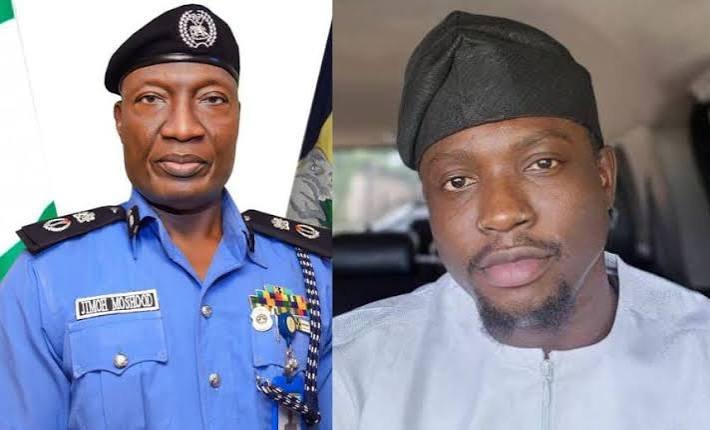
What began as a social media dispute between activist Martins Vincent Otse, popularly known as VeryDarkMan, and Assistant Inspector-General of Police Moshood Jimoh has grown into something considerably weightier, a real test of how the Nigeria Police Force handles accountability when allegations touch its own senior ranks, and whether a high-profile murder investigation was conducted properly in the first place.
The dispute centers on the police investigation into the 2023 killing of Sheriff Salami and the 2024 killing of Prince Ademola Akinloye in the Ajiran area of Eti-Osa, Lagos, and specifically on whether that investigation followed due process. For weeks, VDM has used a series of videos to allege that businessman Ahmed Akanbi was wrongly implicated in the murder case, claiming that suspects initially arrested made no mention of Akanbi in their original confessional statements, only for later statements tying him to the crime to surface under what VDM describes as pressure. He has also alleged torture during the investigation and suggested attempts were made to manipulate the case’s outcome, insisting documentary evidence backs his claims and repeatedly calling for an independent probe.
The controversy has since taken a new turn, shifting partly onto VDM’s own refusal to appear in Lagos to answer questions. “I am not coming to Lagos,” he declared in a recent video, citing concerns for his personal safety. His preferred solution is relocating the matter entirely, arguing that the investigation should be transferred to Abuja, where Force Headquarters and the Force Criminal Investigation Department could take over. His objection is specifically tied to AIG Jimoh’s continued oversight of the Lagos command. “If there were another AIG in charge of the Lagos command, I would go. But as long as AIG Moshood Jimoh remains there, I will not honour any invitation from Lagos regarding this matter,” he said, adding that he fears false allegations could be leveled against him or evidence planted if he travels there, and that he plans to petition the Inspector-General of Police to move the case’s suspects to Abuja over similar safety concerns.
Rather than engaging VDM directly on social media, the police have pursued a deliberately split strategy, separating the underlying criminal trial from the internal administrative investigation into Jimoh’s conduct. In a statement from Force spokesperson CSP Ani Iniedu, the police emphasized that the Ajiran murder case has already been investigated and formally charged to court following advice from the Directorate of Public Prosecutions. “The criminal matter referenced in public commentary was investigated and is now before a court of competent jurisdiction following the advice of the Directorate of Public Prosecutions. As the matter is sub judice, its adjudication rests solely with the judiciary,” the statement read, with the Force reiterating it would not litigate the case through media commentary or allow public pressure to shape judicial outcomes.
Separately, though, the police confirmed that the Assistant Inspector-General overseeing the Force Criminal Investigation Department has formally invited Jimoh for questioning over the allegations raised against him, while the FCID Headquarters in Abuja has similarly invited VDM to appear and substantiate his public claims. The Force framed both invitations as proof that misconduct allegations are investigated “regardless of the rank of the officer involved or the public profile of the complainant,” noting that complaints against officers move through established channels including the FCID, the Force Complaint Response Unit, and where necessary, the Office of the Inspector-General.
That dual-track approach leaves the Inspector-General navigating a genuinely delicate balance, protecting the integrity of an active murder trial while ensuring allegations against a senior officer receive a fair, independent hearing rather than one shaped by public pressure. Traditionally, the Force has kept disciplinary matters out of public view until investigations conclude and sanctions, if any, are formally announced, which helps explain its insistence on treating the murder case and the administrative complaint against Jimoh as entirely separate processes.
Beyond the personalities involved, the episode raises a more fundamental question about whether police investigations more broadly are conducted with the objectivity and professionalism the justice system depends on, since flawed investigative work can ripple outward to affect suspects, victims, and families alike. It also underscores the growing role digital platforms and individual citizens now play in pushing institutions toward accountability, even as the police caution that serious allegations still need to move through formal, lawful channels rather than being resolved by public pressure alone. “Allegations must be formally submitted, investigated and objectively assessed. Any officer found culpable following investigation will face sanctions in accordance with the law,” the Force said.