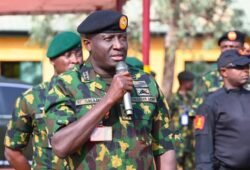


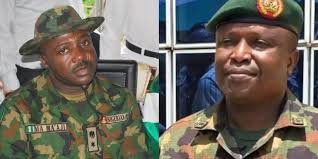
Fresh court records have laid out an unusually detailed account of what allegedly led Colonel Mohammed Ma’aji, one of several military officers accused of plotting to overthrow President Bola Tinubu’s government, to become involved in the scheme, with the officer himself framing his actions not as treachery but as a desperate response to worsening conditions facing both soldiers and ordinary Nigerians.
Ma’aji’s explanation, contained in newly disclosed court documents, describes a plan that emerged gradually among a group of military personnel and civilians before being suspended and later revived. The Defence Headquarters has declined to comment on the details, with Director of Defence Information Major-General Samaila Uba stating that doing so while the case remains before the courts would amount to sub judice.
In his own words, Ma’aji insisted his involvement stemmed from genuine patriotism rather than personal gain, describing years of mounting frustration over governance failures, insecurity, and deteriorating welfare conditions within the military itself. “What has happened has a very long history, and it is driven by patriotism and I love the job and country. Every time I look at how I’m struggling to raise five children with my meagre salary, I get worried. Looking at every aspect of life in Nigeria, there is no hope for the common man, and we are left to defend ourselves. This has nothing to do with any ambition or personal goals. It is purely out of the desire for a prosperous country that works for everyone,” he said.
According to Ma’aji, the movement had not progressed beyond mobilisation and internal discussions when security authorities intervened, with no specific date ever set for any action. He denied any foreign involvement in the plan, though he acknowledged that different individuals joined the discussions at various stages, some raising genuine concerns about the country’s direction, others eventually withdrawing or failing to deliver resources they had initially pledged.
Personal disappointment also played a role in his account. Ma’aji said his failure to secure promotion to brigadier-general on two separate occasions fed directly into his frustration, and that colleagues had encouraged him to revive the movement following the second setback. He traced the plan’s origins back to the Buhari administration, though he said his arrest and subsequent detention had fundamentally shifted his perspective, leading him to recognize alternative, lawful channels for expressing grievances within the military. “If God willing, the authority is kind enough to pardon us, we will never contemplate this course of action again in the future,” he said.
Much of Ma’aji’s testimony reads less like a defence and more like a detailed policy critique of military welfare conditions. He called for a formal channel allowing personnel to raise concerns directly with the Chief of Army Staff without fear of retaliation, alongside broader improvements to remuneration, healthcare, housing, and pension support. He was particularly pointed about the military’s handling of wounded soldiers, arguing that how casualties are treated directly affects morale among troops still serving in operational theatres, and criticized what he described as favouritism in postings and career advancement, noting that some officers had spent nearly a decade continuously deployed while others had never served in the North-East at all.
His concerns extended beyond the military into broader national issues, including the cost of living, education access, corruption, and the fallout from fuel subsidy removal. He argued the subsidy should have been phased out gradually rather than removed abruptly, and urged government to redirect the resulting savings toward projects that genuinely ease hardship for ordinary citizens, such as mass transportation infrastructure. He was equally direct about corruption, describing it as “the mother of all crimes” and pointing to budget padding and unfulfilled welfare policies, including a long-abandoned car loan scheme, as evidence of institutional neglect toward service personnel.
Ma’aji offered a particularly stark illustration of pension shortfalls, recounting a conversation with a fellow officer. “Col Adamu told me that his pension cannot buy his BP drugs. I feel sad when I saw CDS ordering ex-servicemen to be dispersed from their protest ground for improved pensions. We should remember that we shall all retire. Our ex-servicemen deserve better treatment. Charity begins at home; that is why I am starting from the armed forces,” he said.
Throughout his statement, Ma’aji maintained that the plot was never intended to destabilize the country, framing it instead as an expression of love for Nigeria gone in a misguided direction. “Everything we planned was borne out of patriotism, love of country, and the desire to have a prosperous Nigeria that we all can be proud of,” he said, appealing to authorities to weigh the circumstances behind the plot and extend leniency to those involved as first-time offenders. “We are pleading for a pardon and a chance to amend our ways. Many of the officers have participated in some operations in the North-East. I am happy nobody has been hurt,” he added.
Reflecting on his time in detention, Ma’aji described the experience as challenging but ultimately clarifying, saying it gave him space to reconsider how grievances should properly be voiced. He closed by requesting an opportunity to meet directly with relevant authorities to apologize formally and commit to pursuing lawful, peaceful avenues for addressing concerns going forward.