

The Nigeria Customs Service (NCS) has announced that it exceeded its 2025 revenue target by 10.24 per cent, generating ₦7.28 trillion despite multiple government-approved tax waivers and fiscal incentives introduced to support key sectors of the economy.
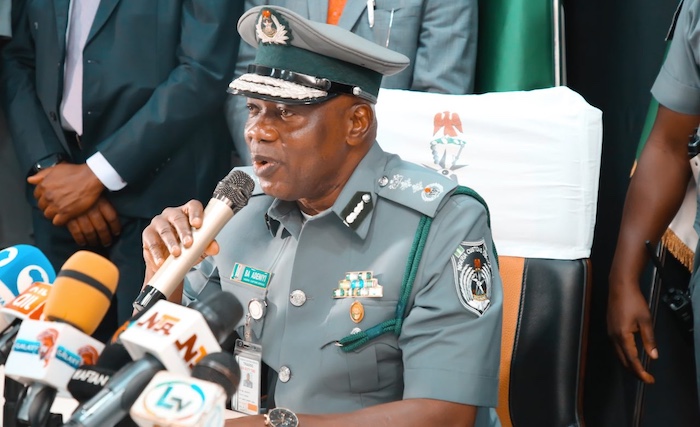
Comptroller-General of Customs, Adewale Adeniyi, disclosed this on Monday while defending the agency’s 2025 budget performance and presenting its 2026 budget proposal before the House of Representatives Committee on Customs and Excise.
According to Adeniyi, the Service surpassed its annual revenue target of ₦6.58 trillion by about ₦696 billion, attributing the achievement to ongoing reforms in revenue administration, automation and trade facilitation.
He explained that the performance was recorded despite several policy measures that reduced Customs earnings, including the continued suspension of excise duty on telecommunications services, healthcare-related waivers, tax concessions on pharmaceutical products and duty exemptions granted under the Presidential Compressed Natural Gas (CNG) initiative.
The Customs boss further revealed that imports valued at about ₦34.53 trillion benefited from various exemptions and waivers during the year, including military equipment and other strategic imports approved under government intervention programmes.
Adeniyi also cited disruptions in global supply chains caused by geopolitical tensions in the Middle East, which affected imports of key commodities and constrained revenue generation.
On expenditure, he disclosed that although the Service had an approved budget of ₦1.13 trillion for the 2025 fiscal year, only ₦808.86 billion was available for implementation.
He attributed the shortfall to the transition from the former seven per cent Cost of Collection funding arrangement to the four per cent Free-on-Board (FOB) Cost of Collection mechanism introduced under the Nigeria Customs Service Act.
According to him, the available funds were utilised for personnel costs, capital projects, overhead expenses and concessionaire obligations.
Looking ahead, the Service is targeting ₦11.07 trillion in revenue for the 2026 fiscal year.
Adeniyi said the projection would be driven by deeper automation, stronger post-clearance audits, intelligence-led enforcement and improved trade facilitation measures.
Central to the strategy is the Unified Customs Information System, popularly known as B’Odogwu, which he described as a robust platform designed to enhance efficiency in customs operations and revenue collection.
He added that reforms implemented in collaboration with international partners, including the International Monetary Fund and the World Customs Organisation, have strengthened the agency’s audit and compliance systems.
The Comptroller-General also disclosed that recently approved reductions in vehicle import duties could influence revenue performance in the coming year.
According to him, import duty on used vehicles has been reduced from 15 per cent to five per cent, while duty on new vehicles has been cut from 20 per cent to 10 per cent.
Meanwhile, the Service has proposed ₦421.7 billion for personnel costs, ₦307.77 billion for overheads and ₦565.93 billion for capital projects in 2026, with spending expected to focus on infrastructure development, operational equipment and expansion of ICT systems.
The Customs Service has maintained a steady rise in revenue generation in recent years through modernisation reforms, tighter enforcement and digitalisation, even as government continues to balance revenue objectives with economic policies aimed at promoting investment and reducing business costs.