

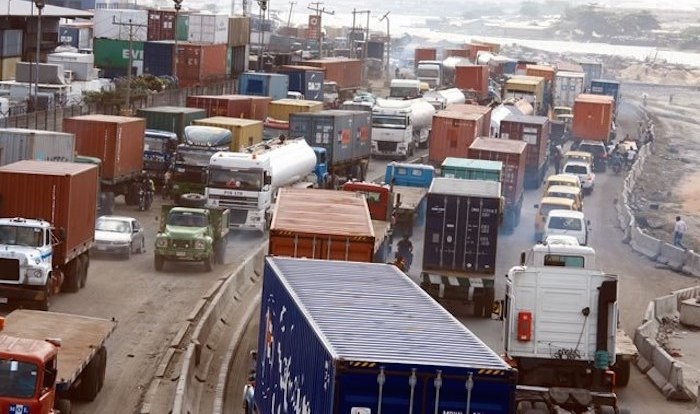
Residents, motorists and business owners along the Berger–Kirikiri corridor have blamed the persistent traffic congestion on the Mile 2-Apapa Expressway on the increasing number of container terminals operating within the area.
The gridlock, which left thousands of commuters stranded for hours on Monday, disrupted economic activities and forced many travellers to abandon their journeys and return home.
An auto dealer, Ekene Iruanya, described the container terminals as the major cause of the perennial traffic challenge, noting that the situation worsened after the facilities began operations.
According to him, trucks transporting empty containers to the terminals frequently occupy large sections of the road, creating bottlenecks despite the presence of traffic management officials.
“There is nothing else causing this traffic other than the terminals opposite the Catholic Church. Before they came here, this road was free. Today, you have three different terminals receiving containers and all the trucks are heading there,” he said.
Iruanya added that personnel of the Nigerian Navy, the Lagos State Traffic Management Authority (LASTMA), the Federal Road Safety Corps (FRSC) and other security agencies are regularly deployed to the area, but their efforts have produced limited results due to the volume of trucks on the corridor.
He called on the government to review the location of the terminals, arguing that relocating or shutting down some of the facilities would significantly reduce traffic congestion around Kirikiri, the Nigerian Correctional Service facilities and the Naval Barracks.
However, a representative of one of the container terminals denied responsibility for the gridlock, stating that several terminals operate within the corridor and receive similar cargo.
The official explained that the terminal currently handles only empty containers and has become busier because some neighbouring facilities are no longer operating at full capacity.
According to the official, the terminal receives between 150 and 200 empty containers daily and can only admit new deliveries after previously stored containers have been evacuated to the ports.
The official further maintained that many of the trucks contributing to the congestion belong to independent transport operators and suggested that stricter traffic management could improve traffic flow along the corridor.
Meanwhile, the Nigerian Ports Authority (NPA) said it is collaborating with relevant stakeholders and security agencies to tackle the recurring traffic congestion on the Mile 2-Apapa port corridor.
NPA spokesman, Ikechukwu Onyemechara, disclosed that government agencies recently established a WhatsApp platform to facilitate swift reporting and response to traffic incidents on port access roads.
He explained that agencies such as LASTMA are immediately alerted whenever congestion occurs, enabling them to deploy personnel to affected locations and keep portions of the road accessible to other motorists.
Onyemechara also urged tanker operators to maintain orderliness and avoid obstructing major roads, stressing that cooperation among stakeholders remains critical to finding a lasting solution.
He, however, acknowledged the challenges associated with sanctioning erring tanker operators, alleging that attempts to enforce discipline are often met with threats of industrial action and disruption of fuel distribution.
The NPA spokesman further revealed that some tank farm operators are yet to fully adopt the electronic call-up system introduced to regulate truck movement into the ports, a development he said continues to contribute to traffic congestion around Mile 2.
As efforts continue to address the challenge, stakeholders have called for urgent and coordinated action to ease congestion, improve traffic flow and minimise the economic losses associated with the recurring gridlock along one of Lagos’ busiest transport corridors.