

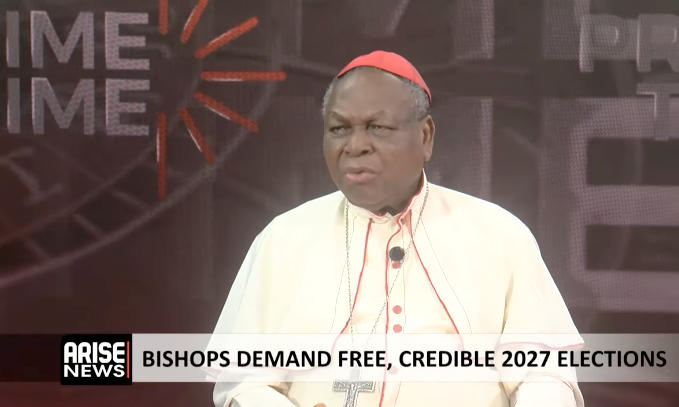
Cardinal John Onaiyekan has made clear he has no interest in a public back-and-forth with government spokespersons following the Catholic Bishops’ Conference of Nigeria’s recent meeting with President Bola Tinubu, insisting the bishops already said what they came to say and are now watching only for whether it changes anything.
Speaking in an interview with Eagle 102.5 FM’s current affairs program Frontline, the Archbishop Emeritus of Abuja addressed the fallout from the CBCN’s July 28 meeting with Tinubu at the State House, where the bishops presented their assessment of Nigeria’s economy and security situation. When pressed on the Presidency’s response to that meeting, Onaiyekan declined to engage at all. “I would not even answer that question. We have no response for them. We have spoken and the only response we are waiting for is whether it is affecting the way they are governing,” he said, adding that reactions from government supporters and spokespersons were simply not his concern. “That some of the supporters of government and the state and spokesperson may have their own idea about what they think they should be saying on behalf of their principal, is their business, not mine.”
The Cardinal pushed back firmly against any suggestion that the bishops had approached the meeting as narrow advocates for Catholic interests. “We didn’t go there just as Catholic bishops pushing the Catholic agenda. No. We went there as people who are with the spiritual mandate to speak to anybody in the name of God,” he said, framing the visit as an exercise in pastoral responsibility toward all Nigerians rather than a sectarian appeal.
According to Onaiyekan, the audience itself had been months in the making, initiated by the CBCN and delayed considerably before finally being granted. He was careful to distinguish the meeting’s purpose from anything resembling evangelism or institutional promotion. “We didn’t go there to preach to him and try to see whether we could convert him to our Catholic Church, but we went there to share our views and thoughts about the government which he heads, hoping that our ideas will be taken into consideration,” he explained.
Rather than treating the visit as a one-off event, Onaiyekan expressed hope that it marks the start of continued dialogue, with the bishops still anticipating a further opportunity to elaborate on concerns they could only briefly touch on during a ten-minute exchange with the president. “We are hoping that somehow, he will invite us, not necessarily to meet him, I mean President Tinubu, but at least to open up fairness for us to give more information, more concerns that we have, than we could give in the ten minutes talk that we gave to him,” he said.
He was equally direct in ruling out any political motive behind the bishops’ intervention, noting that the document presented to Tinubu had been prepared collectively and approved unanimously by Nigeria’s bishops, and that Church rules bar clergy from party politics entirely. “We don’t have any political ambitions for anything. Even our church does not even allow us to get engaged in party politics. So, even if I wanted to be a presidential candidate, I can’t be,” he said.
Turning to substance, Onaiyekan argued that Nigeria’s economic progress should ultimately be judged by lived experience rather than macroeconomic indicators. “If we admit that the role of government is the welfare of citizens, then it means we are not going to judge the success of our government on the basis of the statistics from GDP, from the World Bank, or whatever. The important thing is, what, how is the life of the Nigerian?” he said. He singled out youth unemployment as among the country’s most urgent problems, describing graduates unable to find work despite years of education, a situation he said leaves young Nigerians unable to plan marriage, family, or any semblance of a stable future. “The terrible thing now is many of our young people that have struggled to finish university are all going around with their degrees. They are unable to get a job. Therefore, they can’t even think of marriage. They can’t think of starting a family. They can’t think of planning their life. That is terrible,” he said, warning that the resulting frustration poses a real risk to the country if left unaddressed. “The only thing it takes is a political will to do the right thing, to be honest in how government is run, to be just to everybody, to be fair in this.”
Looking beyond the Catholic Church, Onaiyekan voiced hope that other religious leaders, Christian and Muslim alike, would take up similar engagement with the government, floating the idea of a broader interfaith meeting with the president. “We are hoping that our message will be shared by other religious leaders in Nigeria, first other Christians in the context of CAN and, indeed, other believers, including our Muslim religious leaders. It would be wonderful if we could organise a meeting with Mr. President and all the religious leaders in Nigeria, talking together,” he said.