

Thousands marched across South Africa on Tuesday demanding the departure of undocumented foreign nationals, the climax of a weeks-long campaign that has already killed four people and pushed more than 25,000 migrants to leave the country. What stands out is not the scale of the protests themselves but what the government’s response reveals, a state simultaneously enabling a mass exodus and trying to prevent it from becoming 2008 or 2021 all over again.
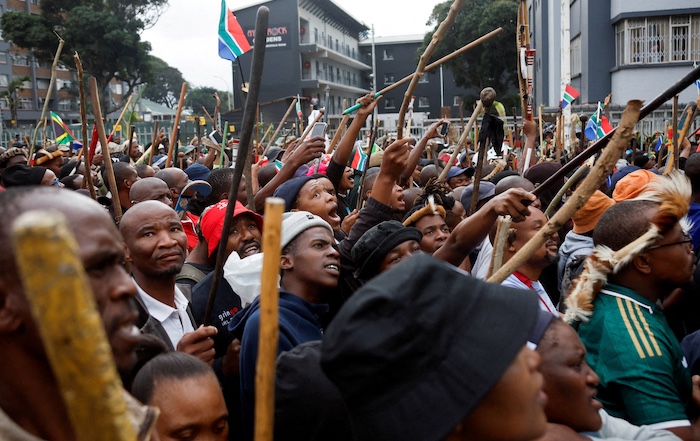
Vigilante groups behind the movement set an unofficial June 30 deadline for undocumented foreigners to leave, and Tuesday’s marches in Johannesburg, Durban and Cape Town were meant to enforce that ultimatum publicly. In Johannesburg, security forces had to escort foreign nationals away from a mob carrying sticks. In Durban, protesters marched in traditional Zulu attire carrying spears and shields. Cape Town’s turnout was comparatively small, about 100 marchers, and it walked straight past a counterprotest against xenophobia, a reminder that the anti-migrant push is not a national consensus so much as a loud and organized faction.
The government’s dilemma is that it cannot simply dismiss the movement’s underlying grievance, even as it works to contain the violence attached to it. March and March leader Jacinta Ngobese-Zuma framed the demand plainly, calling for mass deportation within six months and blaming undocumented foreigners for unemployment above 30 percent. Analysts describe this as scapegoating for government failures on jobs and services, but the material conditions driving frustration, like demonstrator Brightness Gumbi’s complaint that she cannot afford business premises while migrants apparently can, are real enough that the movement has traction regardless of whether the blame is accurately placed.
What makes this flare-up different from South Africa’s previous xenophobic violence, including 2008’s 62 deaths and 2021’s roughly 350, is that neighboring governments have started organizing their own response in parallel. Nigeria, Malawi, Ghana, Zimbabwe and Mozambique have all arranged repatriation flights and buses, the first time regional governments have coordinated departures simultaneously rather than leaving migrants to flee individually. That coordination is itself a signal of how seriously those governments are taking the threat to their citizens.
On the ground, the human cost of that calculation is stark. A 23-year-old Zimbabwean woman waiting with roughly 2,000 others for buses in Cape Town described landlords evicting tenants and employers firing workers, all preemptively, out of fear of fines or vigilante attacks. A Malawian man in Durban said he left not because he was forced out directly but because neighbors warned him the night before.
President Cyril Ramaphosa’s response, tightening immigration enforcement while asking traditional leaders to calm tensions, tries to satisfy both sides of the equation without fully committing to either. Labour analyst Dale McKinley’s assessment that the campaign has been politically weaponized ahead of November’s local elections suggests the timing is not incidental. Whether the security deployment prevents a repeat of past bloodshed may depend less on policing Tuesday’s marches than on what happens to the tens of thousands still deciding whether to wait it out or go.