

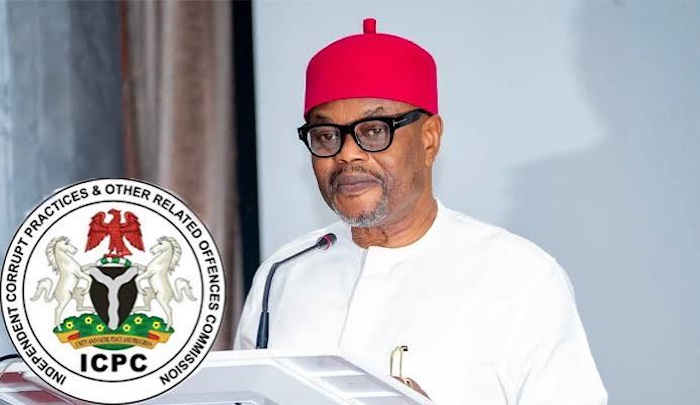
The Independent Corrupt Practices and Other Related Offences Commission (ICPC) has confirmed the arrest of former Minister of Science and Technology Uche Nnaji over allegations that he forged academic certificates.
In a statement posted on its website Wednesday evening, ICPC’s Head of Media and Public Communications, Okor Odey, said Nnaji was arrested following the execution of a bench warrant issued by the Federal High Court. “The arrest was effected on Wednesday, 1st July 2026 at the Nnamdi Azikiwe International Airport, Abuja, upon Mr. Nnaji’s arrival. He was apprehended with the assistance of the Department of State Services (DSS) and subsequently handed over to the ICPC for further investigation,” the statement read.
According to the commission, it had earlier tried to resolve the matter through cooperation rather than force. It extended a formal invitation to Nnaji through a letter dated 15 May 2026, served to his known addresses in Abuja and Enugu as well as his email address. Despite that, Nnaji did not appear for scheduled investigative interviews, which the ICPC said left it no option but to pursue further legal action. That action culminated in a Federal High Court order, issued 11 June 2026 in Abuja under Suit No: FHC/ABJ/CS/1160/2026, directing the ICPC to arrest him.
The underlying allegations center on two documents Nnaji submitted during his ministerial screening in 2023, a degree certificate from the University of Nigeria, Nsukka, and an NYSC Discharge Certificate, both of which the ICPC alleges were forged. Following his arrest, Nnaji has been taken into custody at ICPC headquarters in Abuja, where the commission said investigations will continue and the matter will be pursued diligently in accordance with the law.
This is not the first time the allegations have surfaced. Nnaji resigned as minister in October after a report claimed he had forged both his NYSC discharge certificate and his first degree certificate. He has maintained that he graduated from the University of Nigeria, Nsukka, in 1975, though the report that triggered his resignation indicated the institution could not verify his academic records.
At the time, Nnaji was careful to frame his resignation as a procedural decision rather than a confession. He said the choice was not an admission of guilt but a principled decision to respect due process and preserve the integrity of ongoing judicial proceedings, adding that he expected justice to eventually vindicate him. He also pointed to his political opponents as the source of what he called a sustained campaign of falsehoods, describing the coverage against him as an orchestrated and politically motivated attack that had caused him personal distress and distracted from his ministry’s work under the Renewed Hope Agenda.
Nine months later, that dispute has moved from public statements into a formal criminal investigation, with Nnaji now in ICPC custody as the commission works to determine whether the certificates at the center of the original allegations were, in fact, fraudulent.